
Build a home that restores energy
instead of draining it.
Stability & Structure is a six-week system that removes the hidden friction quietly consuming your capacity every day — so your home stops working against you and starts holding you up.

SOUND FAMILIAR?
You've tried.
It keeps coming back.
Not the chaos. The cost. The way a normal week quietly empties you before it ends.
• You search for the same things every morning. Keys. Charger. The permission
slip that's definitely somewhere.
• You finish dinner and realise you're not actually present — you're already
tracking what still needs doing before bed.
• Shared tasks generate low-level friction. Nobody is being difficult. The ownership
was just never clear.
• Sunday evenings feel like repair work, not rest. And by Monday morning, the tank
is already lower than it should be.
• You've had stretches where a system held. Then one hard week, and it was gone.

None of this is a discipline problem. It's a structural one.
The friction has been draining your capacity before you ever reach the things that matter.
WHAT'S ACTUALLY HAPPENING
Your home is always working on your nervous system.
The question is in which direction.
Every surface that requires a decision costs something. Every unclear responsibility creates a small drain. Every morning that starts with management instead of movement takes something from the day before it has properly begun.
The brain doesn't experience this as a dramatic drain. It experiences it as the Thursday that felt relentless and left nothing behind. As the irritability that seems disproportionate to what caused it. As the need for twenty minutes to recover from a perfectly ordinary evening.
A stable environment allows genuine recovery. A cluttered, ambiguous one keeps the brain scanning — tracking unresolved items, running background checks, even when you're supposed to be resting. The environment is never neutral.
The solution is not more effort applied to the same structure. It is a different structure.
Week 1: you do the Friction Audit — three days of observation, no fixing yet.
You identify the two or three recurring points draining most of your energy.
Week 2: you stabilise three zones. The morning starts differently. The evening closes differently.
The difference is felt before it can be named.
WHAT CHANGES
Not a perfect home.
A home that stops costing you so much.
You finish dinner and you're actually there. Not composing a mental list, not tracking what still needs doing — actually present. The conversation lands. You choose your words instead of just producing them.
The school bags are by the door. You didn't think about it this morning. The structure decided it last night.
It's Wednesday evening after a difficult day and the kitchen is reset. Not because anyone remembered to ask. Because it's simply what happens now.
• You stop needing twenty minutes to recover from ordinary evenings.
• The same conversation about who handles the kitchen doesn't happen on Thursday. It was settled on Sunday.
• The morning exit takes ninety seconds. No searching. No calling out from the hallway.
• A hard week stays a hard week. It doesn't derail the structure underneath.
• When something slips, you're back to baseline in five minutes — not starting over from nothing.

Calm is not a reward. It is a structural outcome.
It is produced deliberately — by removing what should never have been there.
That is what this system is for.
THE SYSTEM
Three phases.
One non-negotiable sequence.
Most improvement systems fail at the same point — when pressure arrives. Not because the person lacked discipline, but because the system was never grounded in a stable environment. This module addresses that directly. Each phase builds the foundation for the next. The sequence is not flexible. The pace is yours.
PHASE 1 — RESTORE Clear Chaos to Calm Run the Friction Audit. Then stabilise three zones — Kitchen Surface, Entry Zone, Bedroom Reset — that set the tone for every transition in the day. You are not deep-cleaning. You are making calm automatic in the right places. What it feels like: the morning no longer requires a first act of management. It simply begins. |
PHASE 2 — STRUCTURE From Tension to Clarity Once the physical environment stabilises, the hidden friction becomes visible. Structure installs Daily Anchors, a Weekly Reset, and a Responsibility Map. Reminders decrease. Conversations shorten. The household runs by design, not by emotional effort. What it feels like: the kitchen conversation doesn't happen on Wednesday. It was settled on Sunday. |
PHASE 3 — GROW From Effort to Momentum Grow only becomes possible once Restore and Structure have done their job. With friction removed, attention is finally available. One Focus Zone. One anchored habit. Monthly direction. Simple enough to hold on difficult days. What it feels like: you sit down to focus and you actually focus. The environment is set. The work begins. |
THE SEQUENCE Restore → Structure → Grow Every shortcut returns you to the same place: ambitious routines sitting on an unstable floor. Stability must precede structure. Structure must precede growth. The six-week rollout is a framework. The pace is yours. What most people do instead: they start with Grow. One hard week and it collapses, because the floor was never built.lace: ambitious routines sitting on an unstable floor. The six-week rollout is a framework. The pace is yours. |
Each phase removes a specific layer of resistance and makes the next phase possible.
THE CORE PRINCIPLE
Stability before
optimisation. Always.
Behaviour that is structurally supported is fundamentally different
from behaviour that depends on daily motivation.
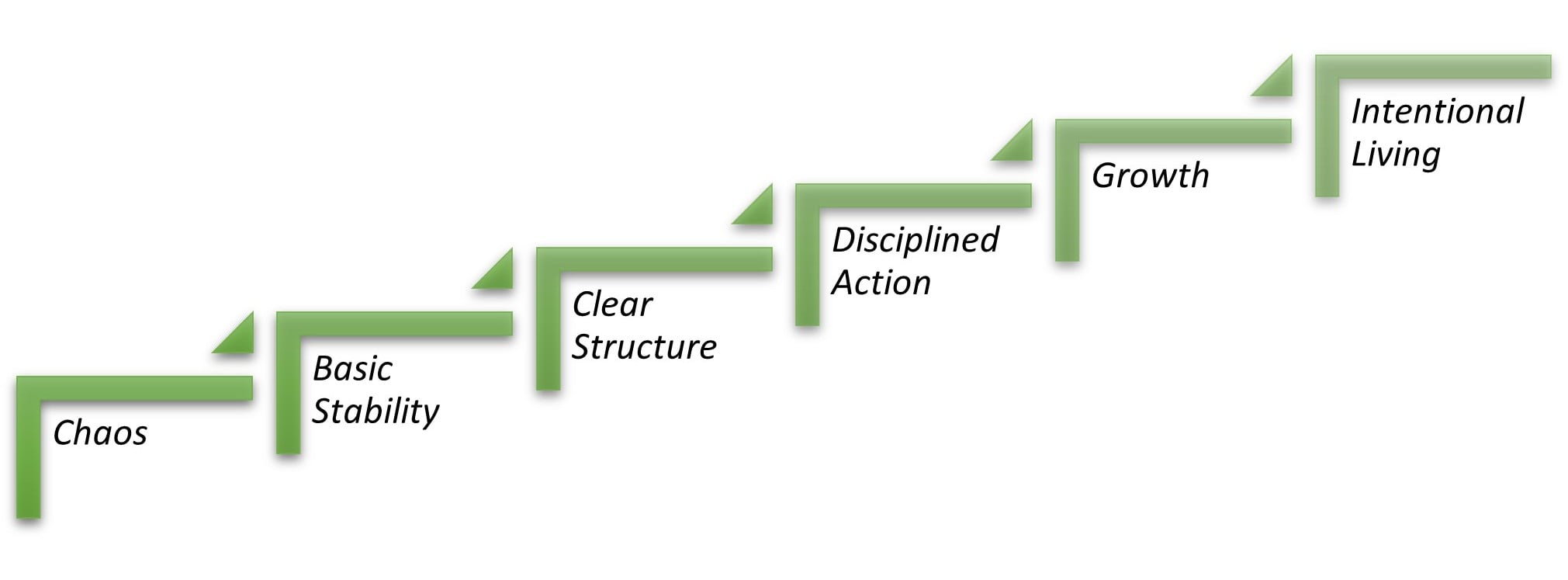
The Stability Ladder in this module places daily life on a six-rung scale — from Chaos to Intentional Living. Most people try to jump from Chaos to Intentional Living by adopting an ambitious routine they found online. One hard week sends them back.
The goal of this module is not to reach the top. It is to move one rung — and have it hold.
WHY OTHER SYSTEMS DON'T WORK
Built for Wednesday evening
after a difficult day. Not for ideal conditions.
Most improvement systems are designed for high-energy moments. They work when motivation is fresh and the schedule is clear. This system is designed for the week where everything costs more than it should — and for households where more than one person needs to cooperate.
TYPICAL SYSTEMS
Focus
Behaviour change through willpower
Shared life
Managed by reminders and emotional effort
Under pressure
Collapses when motivation drops
Over time
Effort increases as the system degrades
Focus
Behaviour change through willpower
Environment redesign through structure
TYPICAL SYSTEMS
Focus
Behaviour change through willpower
Under pressure
Collapses when motivation drops
Shared life
Managed by reminders and emotional effort
Over time
Effort increases as the system degrades
Module 3 — Stability & Structure
Focus
Environment redesign through structure
Under pressure
Holds — anchors are simple enough to repeat on difficult days
Shared life
Responsibility Mapping — the structure holds expectations, not one person's voice
Over time
Effort decreases as stability compounds
GROUNDED IN RESEARCH
Not theory.
Evidence.
The system draws on research from cognitive science, environmental psychology, and sociology. Three principles it is built on:
Willpower is a finite resource — depleted by repeated decisions before it reaches anything that matters. Stable environments restore it. Chaotic ones consume it before the day begins. (Kahneman, Baumeister — cognitive load and ego depletion) |
A cluttered, unpredictable environment keeps the brain scanning even during rest. Genuine cognitive recovery only happens in low-demand, predictable surroundings. (Kaplan & Kaplan — Attention Restoration Theory; Sonnentag — psychological detachment) |
Repeated relational tension in households is usually structural, not personal. Invisible work goes untracked and unequally distributed until the structure is made visible and agreed. (Hochschild — emotional labour; Rodsky — invisible work and full ownership) |
This doesn't feel like self-improvement. It feels like relief.
This doesn't feel like motivation. It feels like relief.
From people like you
A quiet shift.
Then everything feels diffrent.
The friction audit alone was worth it. I didn't realise how much the same five things were draining me every single day. Once I saw the pattern, it took twenty minutes to fix.

Hanna
Mother of three
By week four, I noticed I wasn't tired in the same way on Thursday evenings. Something had been draining me for months that I didn't have a name for. This gave it a name — and a fix.ort enough that I actually did them. All of them.

John
Teacher
We used to argue about the kitchen three times a week. Not dramatically — just that low-level friction every evening. The responsibility map stopped it. Not because anyone changed. Because the structure was finally clear.

Mikel and Sofie
Parents with 2 children
I kept trying to build habits and they kept not sticking. Anchoring them to things that already happened in my day changed everything. They just run now

Eveline
Entrepreneur in IT
THE GUIDED IMPLEMENTATION WORKBOOK
Not more thinking.
A map out.
Open it. Do what's in front of you. By Day 14, the three zones hold. By Day 28, shared tasks run without reminders. By Day 42, the structure is the background of your life — not a project you're managing in front of it.
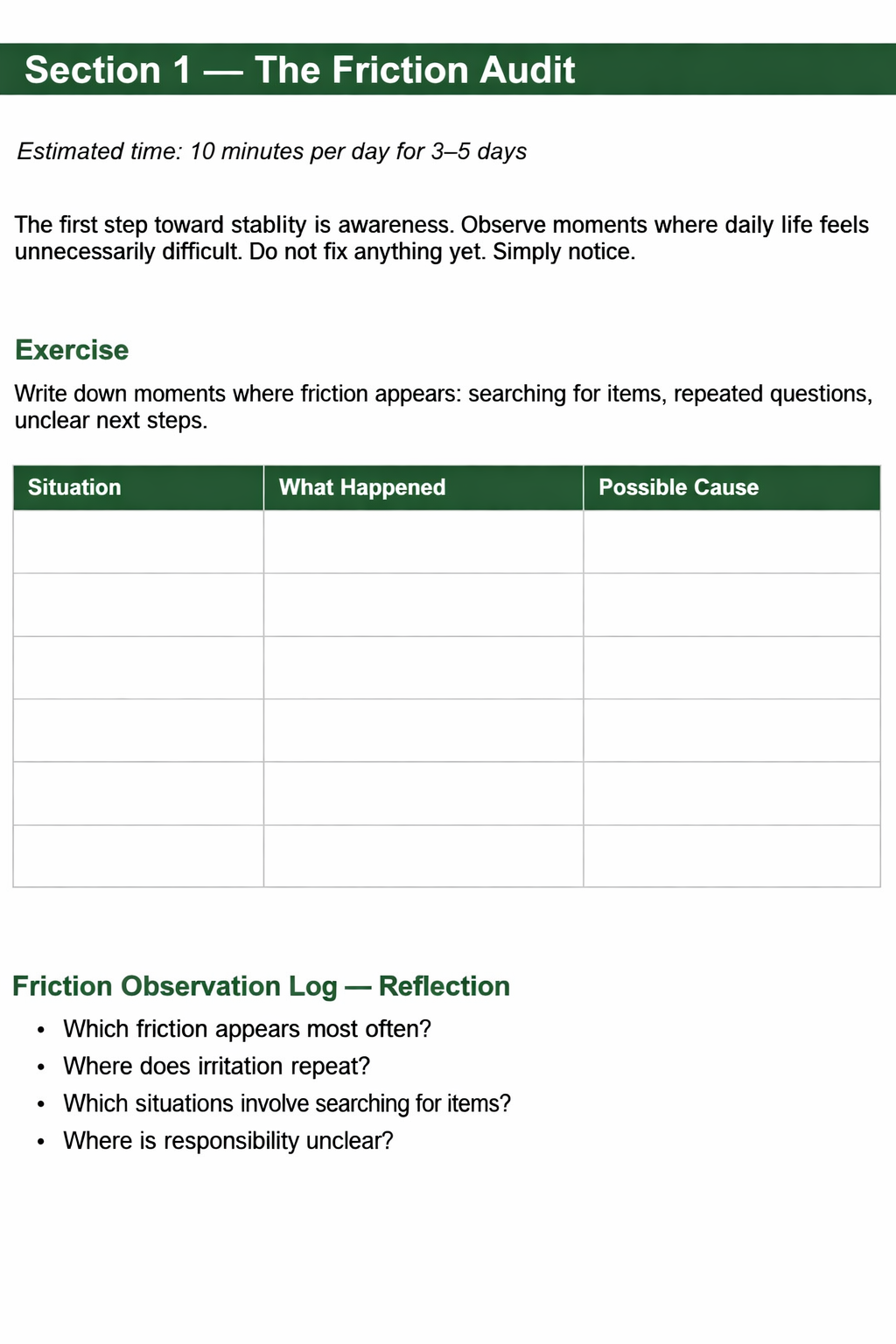
1 | The Friction Audit LogThree to five days of observation. You record moments where energy is being lost repeatedly — searching, pausing, re-deciding — without fixing anything yet. The audit identifies structural problems rather than treating them as personal failures. |
2 | The Three-Zone Reset GuideA stabilisation protocol for the Kitchen Surface, Entry Zone, and Bedroom. Each zone gets a Definition of Done, a daily reset standard, and a six-week stability tracker. The morning starts differently within a week. The evening closes differently. The difference is felt before it's named. |
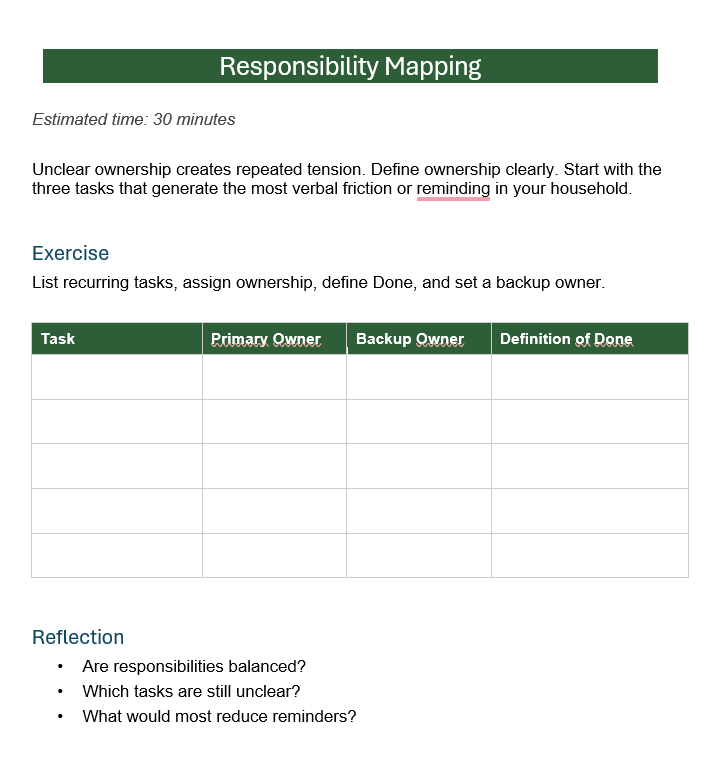
3 | The Responsibility MapPrimary owner. Backup owner. Definition of Done. Rotation rule. Written down, visible to everyone. The ambiguity where resentment quietly accumulates is replaced with a clear agreement. The school bags stop piling up by the stairs. The kitchen conversation stops happening on Wednesday evening. |
4 | The Weekly Reset TemplateFifteen to twenty minutes, once a week. Surface stability check, upcoming pressure points, responsibilities confirmed, one structural improvement. Monday begins with a clear plan instead of the loudest email. The week is directed rather than reacted to. |
5 | The Focus Zone Planner + Habit Anchoring SheetDesign the space that signals focused work to the brain. Attach one new habit to a Daily Anchor it can borrow momentum from. The habit stops depending on willpower. It runs when the anchor runs. |
6 | Monthly Alignment Review + 24-Hour Reset ChecklistA monthly direction check ensures the system is moving toward something, not just maintaining itself. The 24-Hour Reset is five minutes: restore the three zones, recommit to one anchor, choose one focus. You do not start over. You return to baseline and continue. |
What it actually looks like
to use the it.
Each phase has a guide section and a workbook section. Read the guide. Then open the workbook and apply it to your home, your household, your actual week.
1 | Section 1 — The Friction AuditYou log friction moments for three to five days without fixing anything. By the end, you have a clear picture of where energy is being structurally lost — and the pattern is almost always simpler than expected. Two or three recurring points account for most of the drain. |
2 | Section 2 — The Three-Zone ResetYou stabilise the Kitchen Surface, Entry Zone, and Bedroom one at a time. Each zone gets its own Definition of Done, daily reset standard, and a six-week stability tracker. The morning starts differently. The evening closes differently. The difference is felt before it's named. |
3 | Section 3 — Weekly ResetYou run the five-step alignment: zones, upcoming week, responsibilities, friction pattern, one improvement. Fifteen to twenty minutes. The week is directed rather than survived. |
4 | Section 4 — Responsibility MappingYou list the three most friction-generating shared tasks and define primary owner, backup owner, Definition of Done, and rotation. The ambiguity is replaced with a visible agreement. The phrase "how many times do I have to ask?" stops being necessary. |
5 | Section 5–7 — Focus Zone, Habit Anchoring, Monthly AlignmentYou design the space for focused work, attach one new habit to an existing anchor, and conduct your first Monthly Alignment to set a single direction for the month ahead. |
6 | Section 8 — The 24-Hour ResetWhen the system slips, you use this checklist to return to baseline without starting over. Restore the three zones. Recommit to one anchor. Choose one focus. That is enough. |
IMAGE
WHAT'S INCLUDED
The complete Module 3:
The Stability & Structure system.
• The full guide — three phases, philosophy, science, and implementation
• Section 1 Worksheet: The Friction Audit Log — structured observation over three to five days
• Section 2 Worksheet: The Three-Zone Reset — Kitchen Surface, Entry Zone, Bedroom, with a six-week stability tracker
• Section 3 Template: Weekly Reset — five-step alignment to prevent system drift
• Section 4 Worksheet: Responsibility Mapping — primary owner, backup, Definition of Done, rotation rule
• Section 5 Planner: Focus Zone — space design, entry and exit rituals
• Section 6 Sheet: Habit Anchoring — connect one new habit to an existing anchor
• Section 7 Review: Monthly Alignment — high-level direction check
• Section 8 Checklist: The 24-Hour Reset — quick return to baseline when the system slips
Delivered as PDF. Any device. No subscription.
Calm is not a reward. It is a structural outcome.
It is produced deliberately — by removing what should never have been there.
That is what this system is for.
FAQ
No. Module 3 is a complete, standalone system. It builds on the same philosophy but introduces its own tools — the Friction Audit, the Stability Ladder, Responsibility Mapping, and the Grow phase — in full. No prior modules required.
Module 1 redesigns the physical storage and maintenance system of your home. Module 3 goes further — into the structural friction between people, the hidden cost of unclear responsibility, the rhythm that prevents a system from drifting, and the conditions needed for genuine cognitive recovery. They work together. They also work separately.
The Friction Audit is ten minutes a day for three to five days — observation only. The Three-Zone Reset is twenty to thirty minutes per zone, once. The Weekly Reset is fifteen to twenty minutes, weekly. After the six-week rollout, ongoing maintenance is minimal — the structure does most of the work.
The Friction Audit, Three-Zone Reset, Daily Anchors, Focus Zone, and Habit Anchoring are fully relevant regardless of household size. Responsibility Mapping is most useful in shared households — but the core principle of reducing ambiguity and pre-deciding recurring tasks applies to any living situation.
The Friction Audit begins with observation only — you don't fix anything for three to five days. The 24-Hour Reset gives you a way back to baseline in five minutes when something slips. And partial implementation still holds: one zone stabilised, one friction point removed, is already a lighter load than before.
That's built into the design. You don't restart. You use the 24-Hour Reset: restore the three zones, recommit to one anchor, choose one focus. The structure is still there. It just needs resetting — not rebuilding.
Start simple.
Follow the sequence.
Your home should restore you.
Not drain you before the day has started.
The system changes that. In six weeks, one phase at a time.
One surface. One zone. One daily reset that takes ten minutes and keeps the whole thing calm.
Part of The Intentional Living System™ by Obicet.
No prior modules required. Delivered as PDF, any device, immediately.


© 2026 Obicet. All rights reserved.